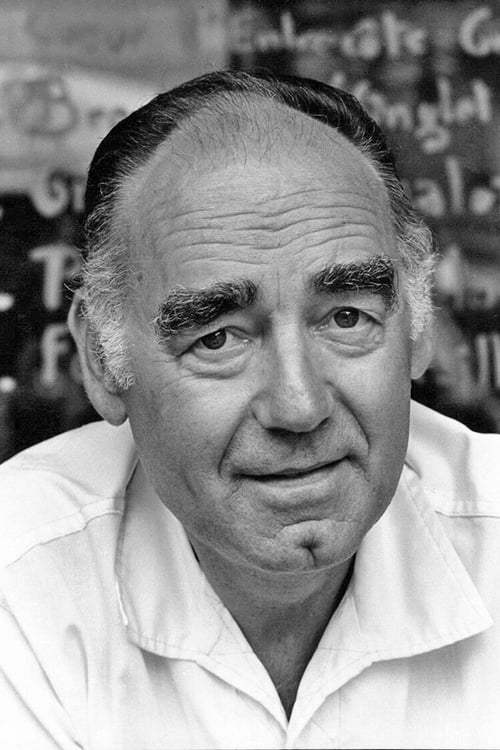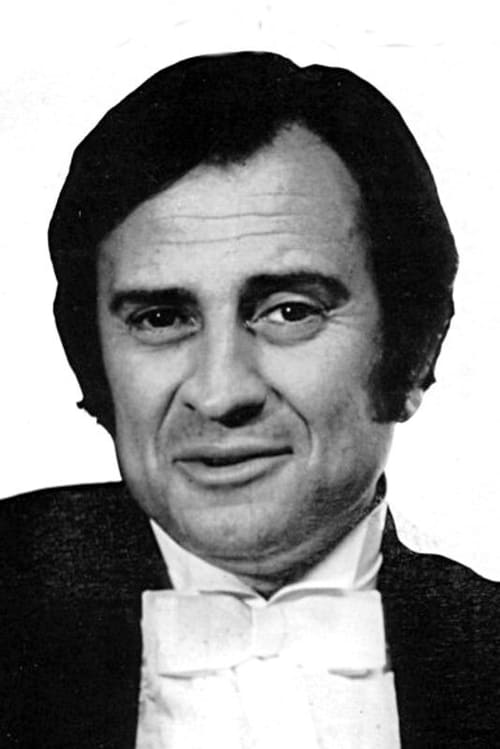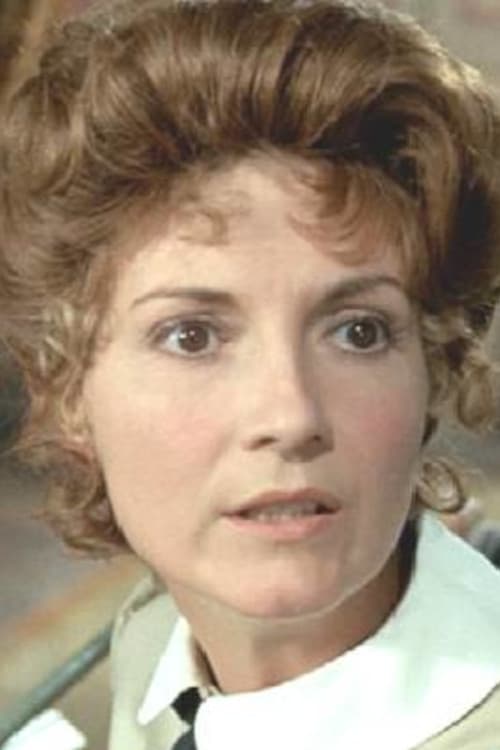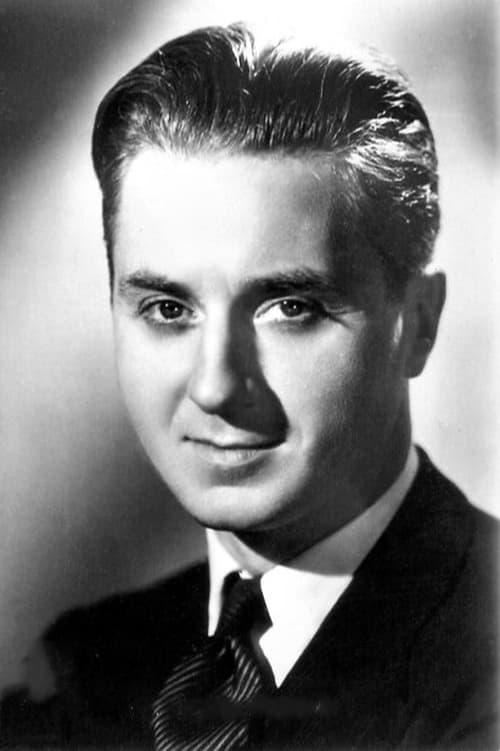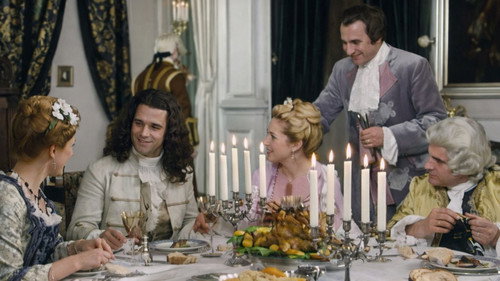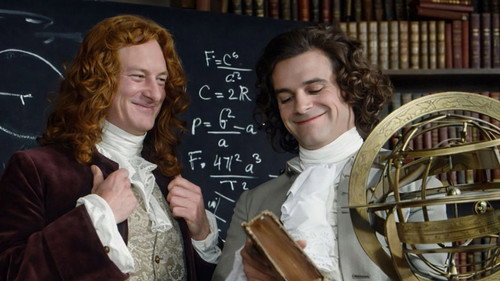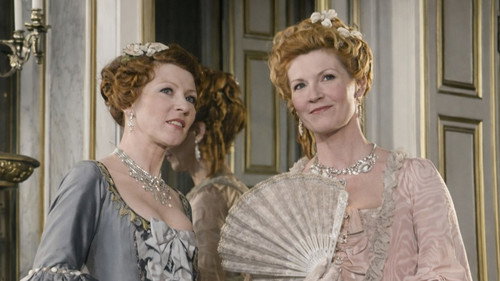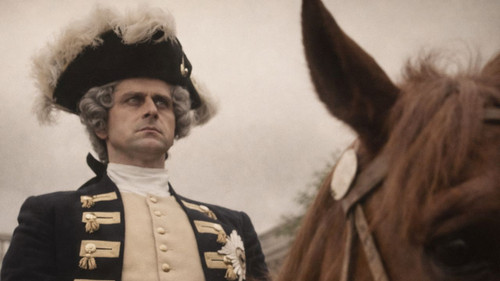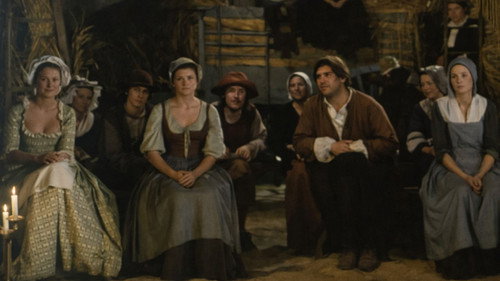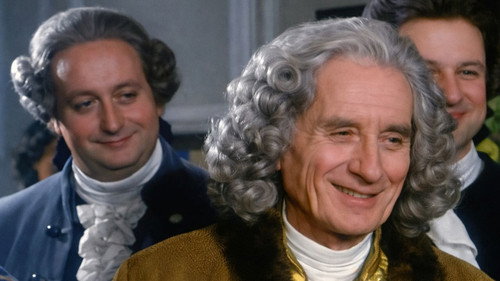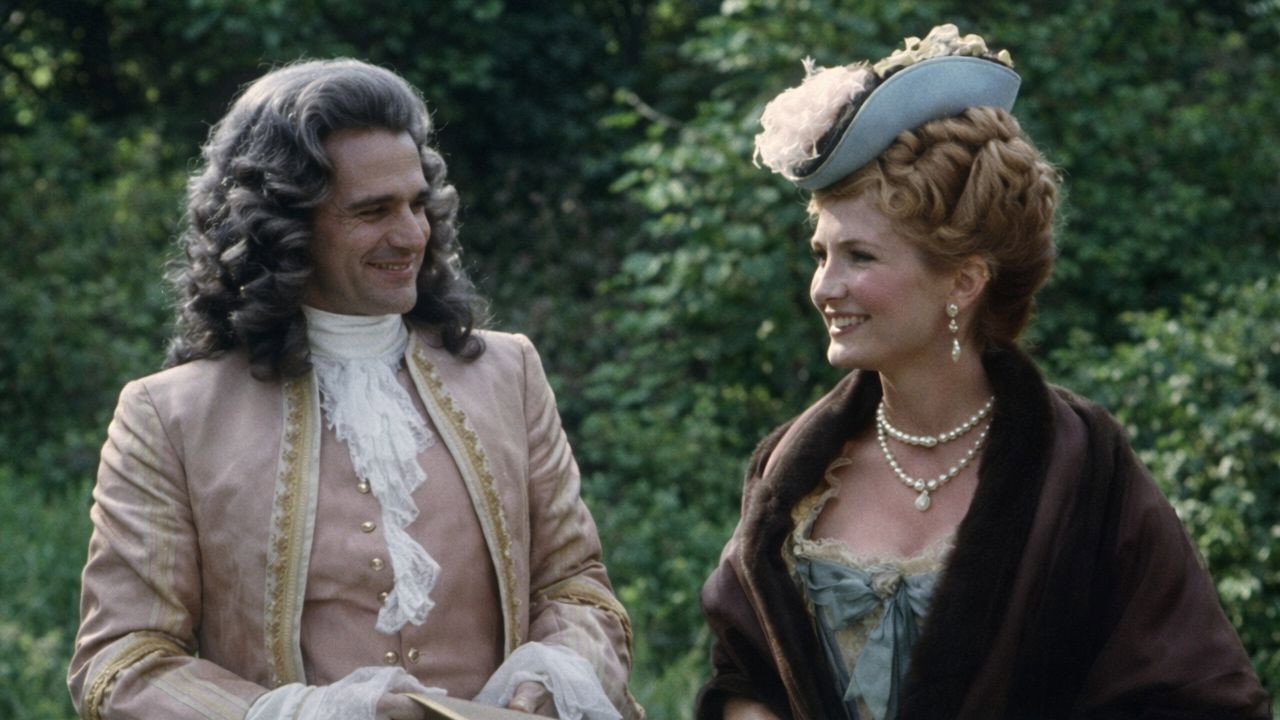

This devil of a man plunges the viewer into the very heart of the Voltaire whirlwind, that incandescent mind who shook his century. The series follows his meteoric rise, his exiles, his battles and flashes of genius, in a Europe still tightly bound by absolutism. We discover an unbowed, charming, formidable man whose pen makes ministers, kings and fanatics tremble. Between glittering salons, damp prisons and passionate loves, Voltaire crosses the Age of Enlightenment like a meteor. Each episode reveals a confrontation, a flight, a victory wrested through the sheer force of intellect. Carried by elegant direction and a sweeping, novelistic energy, the series paints a vibrant portrait of a fighter for freedom. A journey into the life of a man who never stopped thinking, loving and provoking.

Mme Denis

Voltaire jeune

Thiérot

M. Du Châtelet

Duc de Richelieu

La Pompadour

Émilie

Voltaire âgé

In 1704, François Arouet, ten years old, already displayed an uncommon blend of mischief and intelligence. After brilliant studies at the Lycée Louis‑le‑Grand, he decided to become a writer, despite the reluctance of his father, a notary. His romantic escapades led him to the Bastille, where he spent eleven months. Once free again, he experienced his first mutual passion with the sublime tragedienne Adrienne Lecouvreur, and enjoyed his first triumph as a playwright at the Comédie‑Française with Oedipus. From then on, he would call himself Voltaire. Love, fame, fortune and reconciliation with his father all seemed to promise him happiness. But after mocking Monsieur de Rohan—whose illustrious name, in his own mind, justified every insolence—he was beaten. Voltaire challenged him to a duel and found himself imprisoned once more.

Aired: 5/4/1978
Under public pressure, Voltaire’s imprisonment was commuted to exile. In 1726, he therefore landed in London, where he made a series of discoveries that would change his life. But while he philosophized and wrote the English Letters, at the risk of grave danger, Voltaire returned to Paris to see Adrienne Lecouvreur. Hunted by the police, he went back to London disguised as an old man. He did not return until four years later, in 1730, when the exile was lifted.

Aired: 5/11/1978
Trained in the school of English and French philosophers and fond of surrounding himself with brilliant minds, Frederick II spares no intrigue to enjoy Voltaire’s company. He manages to overcome the resistance of Émilie, Marquise du Châtelet, who keeps her protégé at Cirey so that he may complete his great work The Age of Louis XIV. Defying the warnings of his mistress and the king’s anger, he joins his princely admirer. But once crowned King of Prussia in 1740, Frederick II—far from following the political advice of his guest—treats him in a most uncivil manner. Voltaire returns to France, where, thanks to the intercession of d’Argenson and Madame de Pompadour with Louis XV, he is appointed official historiographer, made a gentleman of the king’s household, and—ironically enough—honored with the Pope’s blessing.
Aired: 5/18/1978
Barred from Versailles, Voltaire has only one refuge left: Potsdam, where Frederick II invites him. He goes there, resolved to end his days at the sovereign’s court, and is welcomed with great honors. But things soon sour: Voltaire grumbles, demands favors, blunders repeatedly, speculates on currency, and attacks Maupertuis, one of Frederick’s protégés. He falls into disgrace. When he finally receives permission to leave Prussia, he takes Frederick’s mediocre poems to publish them and take revenge by making Europe laugh. Caught, he escapes, is seized again, imprisoned, and threatened with death. He eventually returns the poems and settles in Switzerland, far from tyrants. Barely has he arrived when news of the Lisbon earthquake spreads. The fanatically Catholic capital is destroyed. The catastrophe inspires his Poem on the Lisbon Disaster, the fiercest of his masterpieces.
Aired: 5/25/1978
Between Madame Denis, his niece and housekeeper — a strong woman whose charms he is not immune to — and Wagnière, his remarkable new secretary and friend, Voltaire sets out to write Candide. At the same time, this indefatigable man continues his quarrel with Jean‑Jacques Rousseau, contributes to The Encyclopaedia, and buys a new house in Ferney, soon to become Europe’s intellectual capital. Then a case breaks out that will cause a great stir. Voltaire learns that a Protestant from Toulouse, accused of killing his son for wanting to convert to Catholicism, has been broken on the wheel. Faced with a murky file, Voltaire reopens the investigation and, if not the man’s life, restores the honor of Calas.
Aired: 6/1/1978
Sixth and final episode. Voltaire has taken in the Calas family, but the Parliament of Languedoc threatens to revolt if the case goes to appeal. Voltaire publishes the Treatise on Tolerance, and Louis XV rehabilitates Calas. Voltaire’s fame becomes immense. Years pass, and the lord of Ferney still has no right to return to Paris, the city where he wishes to die. In Ferney, he builds workshops, drains marshes, and rescues a young woman from a convent, providing her with a dowry and marriage — “Belle et Bonne.” He finally returns to Paris in triumph, receiving extraordinary honors. But after this apotheosis comes horror: illness torments him, and worse, Madame Denis and Belle‑et‑Bonne’s husband confine the dying man to ensure he does not change the will in their favor. Voltaire dies alone, on a poor cot, on 30 May 1778.
Aired: 6/8/1978