NodWatch

A personal movie and TV streaming app built for educational purposes. Powered by TMDB API.

Privacy PolicyTerms of ServiceCookie PolicyReport Issue

© 2026 NodWatch. All rights reserved.

The Search for Solutions

The Search for Solutions

★ 8.5•1980•1 Seasons•ANIME
Documentary

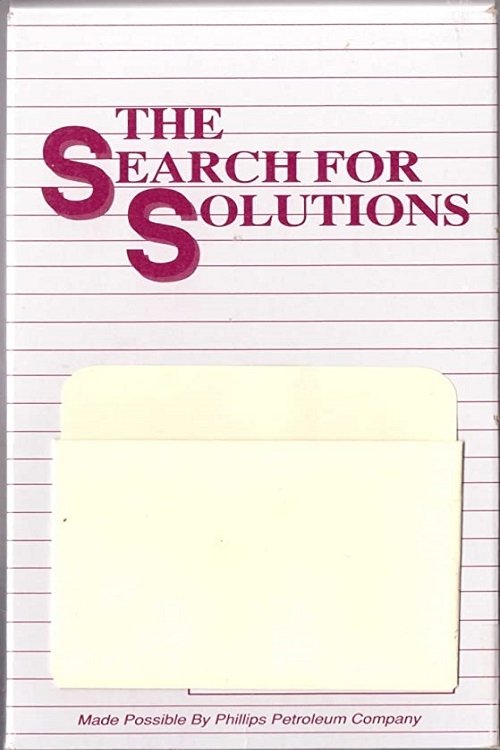
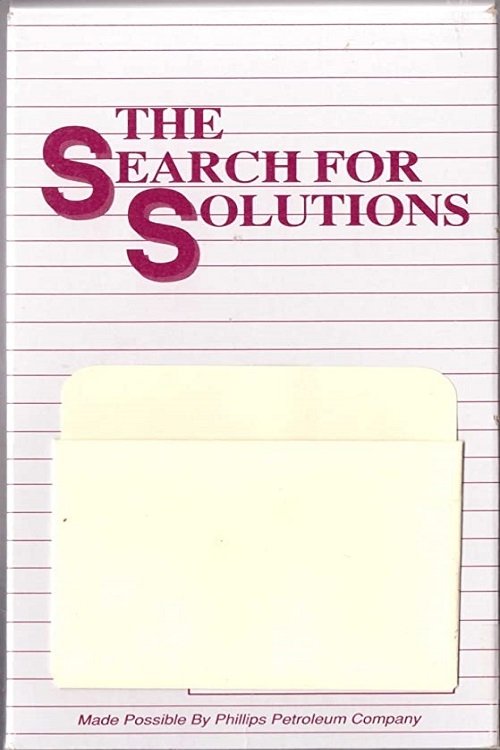
A nine part television series, produced by J.C. Crimmins for PBS. Music composed, arranged and performed by Pat Metheny and Lyle Mays. The stated purpose of “The Search for Solutions” is to stimulate interest in science and technology, primarily among the young. The film comprises nine 18-minute sections touching on various aspects of scientific inquiry that its makers say can be shown as a whole, as it is in this engagement, or in any combination of its parts.

Advertisement

Top Cast

Stacy Keach

Stacy Keach

Narrator

Episodes

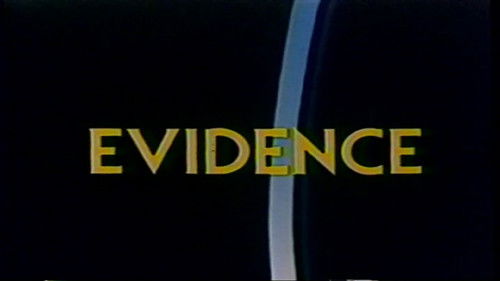
Evidence

1. Evidence

An astronomer discusses his method of collecting photographic evidence; a giant hole in Arizona was learned to be the imprint of a meteorite; a re-enactment of a recorded sighting by English monks; a phone company employee uses his highly-trained ear to listen for subtle signs of disturbance on the phone lines; an epidemiologist was able to deduce why the women and children of a tribe in New Guinea were dying; a criminologist discusses the types of legal evidence used in criminal trials; a psychologist testifies in court about the unreliability of the human memory and a witness's response to police photos; in the case of the man convicted of bank robbery, a criminologist comments on how the witness identifications may have been manipulated; paleoanthropologist Richard Leakey collects evidence of his theory that there were once three human species co-existing in Africa at once; a recent photo of a huge crater on the dark side of the moon may have been the result of a major meteorite.

Aired: 6/10/1980
Patterns

Recommended Anime

Horizon
★ 7.41964

Horizon

Little Einsteins
★ 7.12005

Little Einsteins

NOVA
★ 7.01974

NOVA

Numberblocks
★ 8.42017

Numberblocks

Curious George
★ 7.22006

Curious George

How Do They Do It?
★ 7.62006

How Do They Do It?

Top Gear
★ 7.91978

Top Gear

Snoopy in Space: The Search for Life
★ 7.52019

Snoopy in Space: The Search for Life

Manhunt
★ 7.62017

Manhunt

The Iris Affair
★ 6.42025

The Iris Affair

The World According to Jeff Goldblum
★ 6.62019

The World According to Jeff Goldblum

Advertisement
101 Dalmatians Series
★ 6.61997

101 Dalmatians Series

Limitless with Chris Hemsworth
★ 8.12022

Limitless with Chris Hemsworth

Jonny Quest
★ 8.11964

Jonny Quest

The Busy World of Richard Scarry
★ 7.71994

The Busy World of Richard Scarry

Daniel Tiger's Neighborhood
★ 7.12012

Daniel Tiger's Neighborhood

MegaStructures
★ 7.52004

MegaStructures

The Chelsea Detective
★ 6.32022

The Chelsea Detective

BTS: Burn the Stage
★ 8.32018

BTS: Burn the Stage

Drain the Oceans
★ 7.02018

Drain the Oceans

Similar Anime

On the Edge
★ 8.02018

On the Edge

1000 Days of Fear: The Deadly Race at Los Alamos
★ 6.02015

1000 Days of Fear: The Deadly Race at Los Alamos

I Got Lucky: Survival Stories
★ 8.02021

I Got Lucky: Survival Stories

★ NR2021

Louis T veut savoir

MythBusters
★ 7.82003

MythBusters

Ozone Univerzum - Nemzetközi űrhírek
★ NR2016

Ozone Univerzum - Nemzetközi űrhírek

Science And Islam
★ 8.02009

Science And Islam

Antiques Roadshow
★ 6.51979

Antiques Roadshow

Breakthrough: The Ideas That Changed the World
★ 7.82019

Breakthrough: The Ideas That Changed the World

Building to the Sky
★ NR2019

Building to the Sky

Once Upon a Time... Life
★ 7.81987

Once Upon a Time... Life

Advertisement
If We Built It Today
★ 8.02019

If We Built It Today

How to Grow a Planet
★ 8.42012

How to Grow a Planet

Time Team
★ 7.31994

Time Team

Great Minds Think for Themselves
★ 3.31997

Great Minds Think for Themselves

★ NR2017

2050 dans votre assiette

They Spoke Out: American Voices Against the Holocaust
★ NR

They Spoke Out: American Voices Against the Holocaust

Okna vesmíru dokořán
★ NR1981

Okna vesmíru dokořán

Hot Roads - The World's Most Dangerous Roads
★ NR2011

Hot Roads - The World's Most Dangerous Roads

Bill Nye the Science Guy
★ 7.41993

Bill Nye the Science Guy

Advertisement

Reviews (0)

Advertisement

2. Patterns

An interview with Dr. Geerat Vermeij, a blind University of Maryland malacologist who collects mollusks and examines their shell patterns to determine vulnerability to predators; a look at the shorthand pattern of words, symbols, and gestures used by merchants in the Tokyo fish market; a discussion of Thomas Jefferson's coded correspondence with John Adams; New York Yankees third base coach Dick Howser explains baseball hand signs; an examination of how a meteorologist decodes weather information from tropical cloud formations in order to predict weather; the complex word symbols of the Japanese language; how heat-sensitive photography allows the turbulent patterns of gases and fluids to be analyzed; a look at Spain's Alhambra Palace; an interview with Bernhardt Weunsch of M.I.T., who discusses man's fascination with crystals; and how the Greek translation of Egyptian hieroglyphics on the Rosetta stone allowed linguists to decipher the lost Egyptian language.

Aired: 6/10/1980
Investigation

3. Investigation

How a television camera was used to investigate life below the South Pole ice shelf; the use of a one-million-volt electron microscope in the study of human cells; a look at scientists in Africa who investigate the population patterns of elephants in an effort to end the practice of killing these animals when national parks become overrun with the gargantuan, trunked creatures; an interview with Dr. Charles W. Stockton of the University of Arizona, who studies tree growth rings to determine cycles of drought in the Third World; scientists who use electrical current to stun and study native fish, in a conservation program; a look at the massive radio telescopes in New Mexico used to listen to the stars; an interview with Dr. William S. Hall of the University of Illinois, who is in the process of studying children's behavior and sense of language in an effort to understand how children learn best. Includes a voice-over promo for the second program in the series.

Aired: 6/10/1980
Trial and Error

4. Trial and Error

An interview with David Gordon Wilson of M.I.T. who talks of trial and error as a focused learning process; an interview with Paul MacCready, designer of a flying bicycle called the "Gossamer Condor," relates the process by which the final structure of the Condor was determined; Vincent J. Schaefer recounts his accidental discovery, in 1946, of a way to eliminate the supercooling of clouds which caused airplane wings to ice; a look at the Tour de France, where cyclists and designers continually experiment with ways to increase speed; a discussion of the work of German immunologist Paul Ehrlich, who, in 1901 discovered a cure for syphilis; a scientist who looks in the ocean for organisms, avoided by others, which may contain chemicals that fight disease; and another visit to the Human Powered Championship, including interviews with designers of unusual vehicles.

Aired: 6/17/1980
Context

5. Context

An interview with a scientist who studies the songs of the humpback whale; an interview with an archaeologist who collected and painstakingly documented tiny button-like ancient clay objects -- regarded with disinterest by other scientists, who assumed they were toys or gambling pieces -- which ultimately revealed the origins of writing fifty centuries earlier than previously assumed; the work of German physicist W.C. Roentgen, whose experiments with cathode ray tubes led to the development of the X-Ray; an interview with a scientist whose work yielded an answer to the problem of why sound dies out faster in sea water than in fresh water; Dr. Ralph Nelson and colleague Nancy Bagley discuss their study of the metabolism of hibernating bears, leading Nelson to suggest that an overweight astronaut would be the most logical choice for a long space expedition; designers Ray Merry and Andrew Jones discuss their wind-inflated kite sculptures.

Aired: 6/17/1980
Adaptation

6. Adaptation

A scientist brings solar energy equipment to address the needs of a small Egyptian village; an ingenious solution to the possible loss of blades during a storm from a giant windmill in Denmark; German architect Frei Otto discusses his designs of lightweight buildings; Arthur Riggs and Keiichi Itakura discuss gene alteration; firefighter Captain Fred Bruno discusses a chemical additive which allows more water to pass through small-diameter firehoses; adjustments made by a vigilant Japanese potter's assistant; the adaptations of the desert camel; a scientist from the Norwegian Polar Research Institute describes the adaptations of polar bears to freezing temperatures; swimmer Diana Nyad discusses how the human body reacts to swimming in cold water; Dr. Rolf Sorbye discusses his creation of a motorized prosthesis for a ten-year-old Swedish girl born without a lower arm; an experimental computer system installed in cars in Tokyo, giving motorists directions from a central system.

Aired: 6/17/1980
Modeling

7. Modeling

Sculptor Henry Moore discusses the small-scale working models he creates for his massive bronze sculptures; a designer works with an underwater model of a house with movable windows; an engineer uses a plastic model filled with liquid to study arterial flow of blood in an effort to understand the causes of arterial sclerosis; a football field size model of the islands of Japan and the Inland Sea used to study the paths of industrial pollution; a scientist who studies Indian monsoon patterns with computer simulations; a giant "rain room" in Japan to study erosion; Two doctors test vaccines for malaria on owl monkeys; Dr. Linus Pauling talks about the value of creating models and chemical chain models; astronauts train for the weightlessness of space; a NASA minimal surface researcher uses soap bubbles to create stack-able, space-efficient modules; a scientist creates computer models of the solar system in order to simulate what Voyager will come across on its journey around Jupiter.

Aired: 6/24/1980
Theory

8. Theory

A scientist whose intuitive theory about ancient Native American monuments in the Big Horn Mountains of Wyoming turned out to be true; a discussion of a the theories of continental drift and plate tectonics; the work of French physicist Jean Baptiste Biot, who confirmed that meteorites showered a small French town in 1803; the work of an archaeologist in York, England, who has found evidence of a peaceful Viking domestic and business culture here; an interview with an archaeologist who has found evidence of a Viking pioneer settlement in Newfoundland which also runs counter to traditional perceptions of the Vikings; the work of a British scientist who tracks radio waves from outer space; and the importance of "wild guesses" in science and the daring of Ben Franklin's electricity experiment with kite and key.

Aired: 6/24/1980
Prediction

9. Prediction

Some predictions of sixteenth-century Danish astronomer Tycho Brahe were found to be incredibly accurate; a scientist studies the San Andreas Fault using a laser tracking system and discusses the cause of earthquakes; a "shake table" in Japan that tests construction techniques; a scientist predicts the consequences of earthquakes; the climate of the earth is affected by solar activity; restoration work being performed on the stained glass windows of Canterbury Cathedral; a scientist at the Space Environmental Service Center watches for solar flares to predict high levels of radiation in the; the Dallas Cowboys use computers to compile player data and create strategy, illustrated with footage of running back Robert Newhouse being measured for his fat content in a water displacement tank; a scientist’s research has shown that icebergs may someday be moved to supply fresh water to dry regions; hot-air balloonists in an Iowa competition work with the natural world to control their flight.

Aired: 6/24/1980